

When sleep becomes the reason you keep going back
If you’ve been trying to stop drinking or using drugs, but your nights still feel impossible, you are not imagining the connection. Chronic insomnia can pull you back into substance use, even when you genuinely want to stay sober. At first, it looks like restlessness, racing thoughts at 2 a.m., waking up soaked in anxiety. It becomes a risk factor.
For many people, alcohol or drugs begin as a way to force sleep. A few drinks to shut off the mind. A pill to knock yourself out. Marijuana to quiet the body. Opioids to soften everything. Stimulants during the day, sedatives at night. Over time, that pattern can become its own trap. The substance changes sleep architecture, weakens the brain’s ability to regulate rest naturally, and leaves you even more exhausted the next day.
This is one reason addiction recovery can feel so fragile in the beginning. You may be doing everything right, but if you still cannot sleep, your brain keeps screaming for the one thing it learned might bring relief.
At Seasons in Malibu, sleep problems are not treated like a side issue. They are often central to the whole picture. In a true dual diagnosis setting, insomnia, trauma, anxiety, depression, and substance use are addressed together, because they rarely show up one at a time.
The relationship goes both ways
Sleep disorders and addiction affect each other in both directions.
People with chronic insomnia are at higher risk of using alcohol or drugs to cope. People who already struggle with substance use often develop worse sleep over time, even if the substance seemed to help at first. That is the part many people miss. Sedation is not the same as restorative sleep.
Alcohol is a prime example. It makes you feel sleepy at first but disrupts sleep cycles, leading to more awakenings, lighter sleep, and early morning anxiety. Alcohol interferes with sleep quality and circadian rhythms, even when it seems to help initially.
The same happens with other substances. Cannabis alters sleep quality and causes withdrawal insomnia. Stimulants destroy sleep timing. Benzodiazepines and sedatives can create dependence and a worsening cycle.
So you end up in a cruel loop. You cannot sleep, so you use. Then because you use, you sleep worse. Then because you sleep worse, cravings get louder.
Why insomnia hits so hard in early recovery
Early recovery is physically and emotionally raw. Your nervous system is recalibrating. Brain chemistry is shifting. If trauma, depression, or anxiety were underneath the addiction, they become more visible once the substance is gone.
And then there is the night.
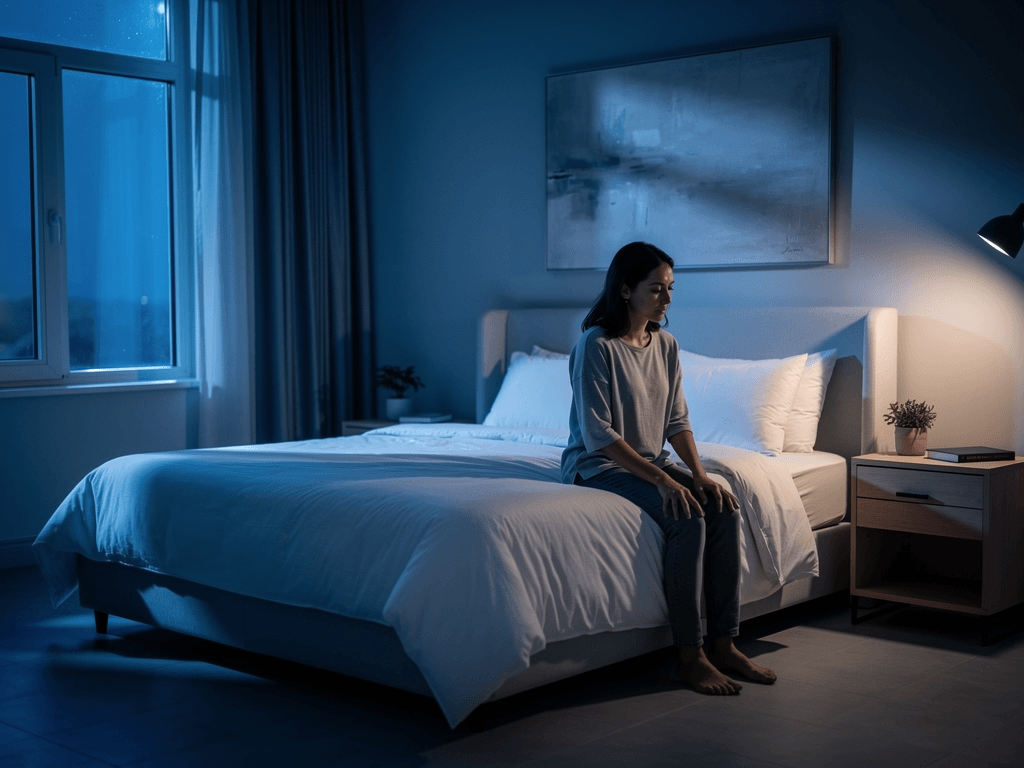
Night can be the hardest part.
During the day, you have structure. People. Therapy. Meals. Motion. At night, there is less distraction. Thoughts get louder. Shame gets louder. Fear gets louder. If your body still does not know how to sleep without alcohol or drugs, the urge to self-medicate can feel less like a choice and more like desperation.
Research backs this up. Sleep disturbance is consistently associated with relapse risk in people recovering from alcohol and drug use disorders. A review in Alcohol Research & Health describes insomnia as both common and clinically significant during recovery, noting that persistent sleep problems may increase vulnerability to relapse.
This is why good treatment does not shrug off insomnia with, “give it time.” Sometimes time helps. Sometimes it does not. When sleep disorders go untreated, they can keep undermining progress that otherwise might have held.

What sleep deprivation does to the brain
When you are chronically sleep-deprived, your brain does not make decisions the same way.
Sleep loss increases emotional reactivity. It weakens impulse control. It reduces your ability to tolerate distress. It can make small problems feel unbearable and cravings feel urgent. The prefrontal cortex, which helps with planning, judgment, and inhibition, works less efficiently when sleep is disrupted. At the same time, the brain’s threat and reward systems can become more reactive.
That matters in addiction recovery.
If your brain is already healing from substance use, and now it is also running on fragmented sleep, you have fewer internal resources available when triggers show up. A bad argument. An anniversary. Physical pain. A lonely hotel room. A wave of panic at midnight. Under-rested brains are more likely to reach for fast relief.
Studies on sleep deprivation have shown impaired emotional regulation and increased reactivity in brain regions involved in threat processing. A widely cited study from researchers at the University of California, Berkeley, published in Current Biology, found that sleep deprivation disrupts the brain’s normal emotional control systems.
Insomnia alone does not cause relapse. People relapse for many reasons. But poor sleep lowers the threshold and makes everything harder to carry.
Why self-medication feels convincing, even when it is failing
Self-medication works just enough to be dangerous.
If you drink and pass out, it can feel like proof that alcohol helps. If you take a pill and get six hours of unconsciousness, it may feel better than another sleepless night. If marijuana makes your body heavy, you may decide it is the only thing that settles you down.
But your brain learns from relief, not from long-term consequences. It remembers, “this changed how I felt fast.” That memory becomes powerful, especially after repeated sleep deprivation.
This is one reason people return to substance use after stretches of real effort. It is not always about wanting to get high or drunk. Sometimes it is about wanting one night of rest. Sometimes it is about wanting the mind to stop attacking itself for a few hours.
When treatment teams understand that, the conversation changes. Instead of framing relapse risk only as poor motivation or weak commitment, they ask better questions. Are you sleeping? What happens in your body at night? Do nightmares wake you up? Does your mind speed up when the room gets quiet? Are there signs of trauma, anxiety, depression, or medication issues that are keeping your nervous system on alert?
Real dual diagnosis care looks like this. It gets specific.
What evidence-based treatment for insomnia actually looks like
One of the most effective non-medication treatments for chronic insomnia is CBT-I, which stands for cognitive behavioral therapy for insomnia. It is considered a first-line treatment by major sleep medicine organizations and has strong research support.
CBT-I is not generic talk therapy with a few sleep tips added in. It is a structured treatment that targets the thoughts and behaviors that keep insomnia going. That may include:
- Changing the habits that train your brain to associate bed with frustration and wakefulness
- Building a more stable sleep window
- Reducing clock-watching and sleep performance anxiety
- Challenging catastrophic thoughts like “if I do not sleep tonight, I will fall apart tomorrow”
- Using stimulus control and sleep restriction techniques carefully and appropriately
- Supporting circadian rhythm repair through timing, light exposure, and routine
A clinical practice guideline from the American Academy of Sleep Medicine recommends multicomponent CBT-I for chronic insomnia disorder. The American Academy of Sleep Medicine recommends CBT-I. https://link.springer.com/article/10.5664/jcsm.6470
For people with substance use histories, this matters. Many sleep medications carry dependence risks or are not ideal in early recovery. Medication can still have a place, especially when a psychiatrist is involved and the clinical picture is clear, but relying only on sedation often misses the actual drivers of insomnia.
At Seasons in Malibu, clients who struggle with sleep may also need trauma work, psychiatric evaluation, nervous system regulation, and one-on-one therapy that looks closely at what the nights are really about. For some, insomnia is tied to PTSD. For others, severe anxiety or depression. For others, withdrawal issues, circadian rhythm disruption, or a learned pattern predating the addiction. That is why a personalized plan matters.
You can learn more about how treatment is structured through our approach and the depth of support offered in one-on-one care.
Sleep problems are often a dual diagnosis issue
Insomnia rarely lives alone.
A person may come in thinking the main problem is alcohol, opioids, cocaine, or marijuana. Then once the substance is removed, the sleep problems are still there. Or they get worse before they get better. Sometimes that reveals an underlying anxiety disorder. Sometimes it reveals PTSD, especially when nightmares, hypervigilance, or startle responses are involved. Sometimes it reveals depression, bipolar disorder, ADHD, chronic stress, grief, or unresolved trauma.
That is why dual diagnosis treatment matters. If a program ignores sleep dysfunction, the person leaves with an unresolved relapse trigger.
At Seasons in Malibu, the treatment team includes doctorate-level primary therapists and master’s-level case managers, which allows for more depth than many malibu rehab centers can offer. Clients may receive up to 65 one-on-one therapy sessions per month. That level of contact creates space to notice patterns that might otherwise get missed, including the emotional and physiological patterns that keep someone awake night after night.
Why environment matters more than people think
Not all sleep treatment happens in a therapy room.
Your environment affects your nervous system. Noise matters. Light matters. Privacy matters. Safety matters. So does whether your body ever gets a chance to slow down.
Setting can make a real difference in well-built luxury rehab California programs. In a chaotic environment, the body stays braced. In a calm one, it can relearn downshifting.
The coastal setting at Seasons in Malibu supports this in practical ways. Natural morning light helps regulate circadian rhythms. Ocean sounds can lower the sense of constant threat some clients carry in their bodies. The quieter residential atmosphere removes a lot of the overstimulation that can keep insomnia going. There is also something very basic, and very human, about waking up to open sky and going to sleep without sirens, traffic, or constant interruption.
The ocean does not cure insomnia. But the right environment supports the work. It helps your body receive the treatment you are already getting.

What healing sleep usually requires
There is no single fix. Real sleep repair asks for several things at once.
You may need medical oversight if withdrawal, medications, or a co-occurring psychiatric condition are involved. You may need trauma therapy if your nervous system only activates once the lights go out. You may need CBT-I if years of frustration have trained your brain to treat bedtime like a threat. You may need structure, nutrition, and consistent wake times.
Most of all, your sleep problem needs to be taken seriously.
That can be hard to find. Many people enter treatment after years of hearing some version of, “just relax,” “put your phone away,” or “everyone’s tired.” But chronic insomnia is not a personality flaw. It is not a lack of discipline. And when it is tied to substance use, it is not secondary. It is part of the clinical picture.
What this means if you are scared you will relapse
If you are exhausted and afraid of what another sleepless night will do to you, that fear makes sense.
Poor sleep can put recovery at risk. It intensifies anxiety, depression, cravings, and hopelessness. It can make a person feel trapped inside their own body. But it can also be treated.
The first step is honesty. Tell the truth about what nights are like for you. Tell someone if you have been using just to sleep. Tell someone if panic starts the minute your head hits the pillow.
That information matters. It can change the treatment plan.
At Seasons in Malibu, addiction recovery means looking at the whole pattern, not just the visible symptom. If insomnia, sleep disorders, trauma, anxiety, depression, and substance use have become tangled together, they need to be treated that way. Together. Carefully. With enough time and clinical attention to do more than get you through the week.
If this sounds like your life, or someone you love, you can reach out to Seasons in Malibu and talk with someone about what is going on. You do not need the whole plan figured out. Just start the conversation.
